
Who's On First?
We certainly don't know who's running Iran, but even more importantly, perhaps neither do they.

There are many forms and varying degrees of rhetorically propping up the Iranian regime (some bordering on hagiography) that I’ve found curious of late.
The first and most inexplicable (to me at least) are the notions circulating in some circles that Iran didn’t represent a substantive threat to vital US interests and is therefore a sort of unwitting bystander who has been attacked out of nowhere. We’ll set that aside for another day.
A close second is the idea that Iran has now “discovered” the power that comes from shutting down traffic the Strait of Hormuz (when it’s something they threaten to do almost annually and it’s the one thing that’s consistently prevented them from being attacked for going on five decades now). Set that aside too.
The third is the notion that they are in any way, shape, or form honest brokers whose public word can be trusted or taken at face value. Let’s don’t kid ourselves here.
The fourth is that despite having managed to achieve the exact opposite of their decades-long strategy to: 1) Unite the Muslim world under their leadership and 2) Deter a direct attack on the regime itself, there remains a consensus that the regime is nevertheless "inevitably winning strategically”. I’m admittedly less convinced.
The fifth and more relevant for our consideration here is the mislabeling of the regime as “ideological hardliners” instead of what they actually are: “corrupt and jockeying ideological hardliners”. An important distinction I don’t often heard made.
The sixth and perhaps most astounding of all is the idea that it’s somehow a strategic strength and not a weakness that in squaring off with a global superpower (and with the weight of the entire world including another global superpower bearing down on you) to devolve decision-making authority to the point that no one figure is in control at all. Is this truly a strategic masterstroke or does it bely something of a “gang that couldn’t shoot straight”? Apologizing for missiles you just fired at your neighbors (and partners / bankers) suggests the latter to me.
And finally, it’s come perhaps a week or two after I would’ve guessed, but it seems commentary is now slowly coming around to the realization that not only do we not know who’s in control of Iranian policymaking, but that they don’t know who’s in control of Iranian policymaking either. Can you identify a single person with decision making authority? The IRGC is not a single person.
Perhaps the first clue of this came when there was a negotiating delegation being recalled from Pakistan and promptly excoriated for “shaking hands with the enemy when the Supreme Leader hasn’t even been buried yet”.
For me, the even bigger clue (if folks had missed that one), should have been evident when the foreign minister of Iran tweeted out that the Strait was “completely open” only to have the state-affiliated media agency Fars immediately publish a piece calling that tweet “unexpected” and for the policy to be promptly reversed. Did our commentariat believe he was confused? Did they believe that such an agreement had not in fact been reached? Or did they just gloss over the fact that such an agreement had indeed been reached, but that the power struggle within Iran meant that such an agreement wouldn’t just shift the balance of power between nations but within the regime itself?
As observers have started to realize, there is indeed a profound division within the government itself and there is no single decision-making authority. [And addendum: as of 4/27, the IRGC-affliated Tasnim is shouting down other hardline outlets for being too critical of the negotiations.]
It’s now being described as “two factions”, but I’m not sure that’s quite right. In other words, it’s not as simple as a “pragmatists” vs “hardliners” contest. That’s a political difference made even less relevant by the hardcore history of all of these individuals. It’s perhaps better seen at this stage as a different strategy for regime survival.
Moreover, it is far too often overlooked, in my view, but if you listen to the folks with direct familiarity and expertise on the Iranian government, they will very quickly point out that all of these people at the top are corrupt. They’ll also point out that the IRGC controls some 45% of the entire economy. So in other words, what they’re fighting for is also a separate matter entirely from what they’re fighting over.
In short, what the “factions” are fighting over isn’t just a foreign policy direction or an abstract idea about “revolution”. What they’re fighting over is also control of assets worth a couple hundred billion dollars.
Three things to note there:
1) It’s very hard to be a true ideologue and also a corrupt one.
2) Even for families who are bound by love and blood, money and greed has a strongly corrosive tendency to rip apart even the strongest of human bonds.
3) When faced with a choice of what Pablo Escobar and the Colombian cartels described succinctly as the “plata o plomo” choice - that is to say “silver or lead”, a significant number of people - judges, ministers, policeman, etc quickly and reliably choose silver. Again and again we see this pattern repeat. We see it with organized crime across nations, cultures, and institutions. In seemingly every case but this one, we’re also quick to note that corruption is hard to prevent, but it’s even harder to eradicate. The regime is lousy with corruption. It’s the entire m.o.
So when I look at where things stand in the war, I must confess that I read the room in Tehran a little differently than the way I hear it framed by most commentators. I don’t see an ideological battle between “reformers” vs “hardliners” (they’re different flavors of the same basic thing) so much as I see a bunch of morally and financially corrupt individuals scheming and scrambling for control of the prize. What is described above aren’t so much identities or beliefs, in my view, as they are strategies to get and stay rich. I’ll return to this distinction momentarily. First, a brief recap of the key players, as I understand them:
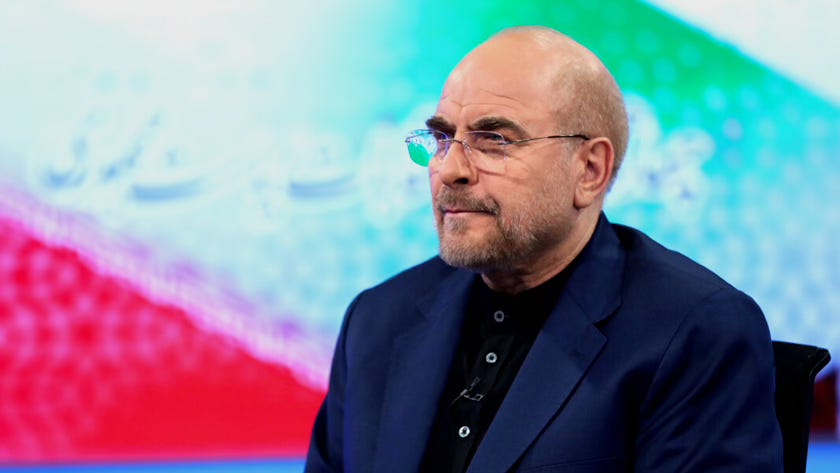
The speaker, Ghalibaf, who has served as the lead negotiator is considered by close regime observers to among the most corrupt. In other words - and you can tell by his choice of suits, frankly - he is pretty clearly a “choose silver” type of guy. Ghalibaf, it’s worth noting, is also very close and has been for a long time with the new Supreme Leader. And as a final note there - as applied to “reformers” writ large, that he’s willing to deal should not be seen as a sort of moral endorsement that “reformer” would tend to imply.
The Supreme Leader, for his part, was installed by the IRGC. His survival and wealth depends on the regime’s survival and wealth and the IRGC is only one piece of that puzzle. It is also less clear perhaps than is commonly understood that the control and power relationship between Mojtaba Khamenei and the IRGC is nuanced.
With what little evidence we have of late, it would seem to me the foreign minister Araghchi is also pretty keen to “choose silver”, despite many public protestations about refusing to deal on enrichment. He was, in fact, seemingly ready eager to trade Hormuz control for blockade removal. Perhaps a somewhat clean swap of “ideology for silver” in other words.
The Iranian president, for his part, ran on (and handily won on) a reform platform explicitly criticizing the government’s failures and expressing a greater willingness to work constructively with the West to get sanctions removed. It’s also been reported of late that he has very grave concerns about impending economic ruin for the country. The people are manifestly with him on that. Make no mistake, he’s far more with the regime than without, but his longstanding public positions (endorsed pretty clearly by the people’s vote when set against hardline candidates preferred by the regime) now pretty closely mirrors what I reckon one could characterize as the “silver” team.
Then we have “the hardliners”… or rather more precisely, the corrupt hardliners.
What I sense (could easily be wrong here) is that these folks truly need to sabotage a deal and rekindle the war if for no other reason than as a means to sideline the others and consolidate control over not just the state or policy direction, but also the spoils.
General Vahidi in particular seems the most likely to benefit in this outcome. As the head of the IRGC itself, it would seem the natural evolution to become the de facto leader of a military-run state. I’m no historian, but I can’t think of many military dictatorships that are truly run by committee. At least not for very long.
But of course, there’s one obvious problem with this strategy, as much as many critics want to hold it up as most likely to prevail here, is that the rekindling of conflict and the sabotaging of negotiations is that in rejecting “silver” as a means of consolidating control, he / they are by default choosing “lead” as the alternative. Not just for the individual seeking control, but also for anyone associated. It’s essentially a bet, at this point, that they can’t or won’t be killed. Would you make that bet standing next to him?
For my own part, I see in Vahidi one man among many who is greedy and corrupt. I don’t see a purity of purpose or sole dedication “to the revolution”. So it is perhaps therefore not a safe or straightforward bet that what we’re looking at is a group of men who are willing to endure any hardship for purity of cause. I see instead a mortal and greedy man (among many) vying for satisfaction of greed - a group who can and perhaps likely will be killed for choosing “lead” over “silver”.
What would you be thinking as you back Mr. Vahidi’s gambit for control?
It does not seem to me that the United States and certainly not Israel are engaged in any sort of bluff here. They’ve proven both willingness and capability to kill folks on their problem list. Thus both the “silver” and the “lead” parts of the offer are indeed sitting right there on the table before the entire regime to have a good long look at. And from the United States at least, there is indeed an awful lot of “silver” on offer.
We should remember too, perhaps, that the “IRGC pie” had already shrunk some 30% over the last fifteen years. Morale amongst the rank and file - even within the IRGC was quite low already. Hyperinflation and 20,000 sorties don’t help with that.
So considering that destruction equivalent to some one-third to one-half of Iran’s GDP has already been sustained through war, the call for more must be getting weighed very carefully all the way up and down the newly redefined chain of command. Those aren’t just state interests, I’d argue, they are personal financial interests getting blown up. And to this destruction must also be added the ongoing seizure of assets and the additional sanctioning and freezing of business partners as well. Thus the more the regime chooses “lead” as a strategy for Vahidi’s success, the more “silver” they are surely losing for the rest of the gang. The already-shrunken pie is shrinking further fast.
In short, for every single one of those folks right up and down the government, the deal simply isn’t getting any better from here. The best day to make a deal was, in fact, yesterday. The cost isn’t abstract for these people, in other words, and it isn’t going down. The trade-off between riches and death for most every human on earth is a very real one. Easy to martyr somebody else for purity of the cause. It’s another matter entirely to martyr one’s self. Similarly, self-martyrdom when there’s nothing left to lose is one thing. When there’s the spoils of a couple hundred billion worth of assets to split amongst the survivors…. well, that’s a different ball of wax altogether.
So as we ponder the struggle for power going on within the regime and engage in thoughtful discussions about geopolitical theory and practice, let us remember too just a few things about ordinary human nature: The instinct for self-preservation is indeed a very strong one. Greed and lust for riches too have tripped up more than a few otherwise principled government officials.
And finally, let us not lose sight of the greatest autocratic truism of them all: What matters most to the regime is not ideological purity, it’s that the regime itself survives. So to put oneself in the shoes of all those with a lot to lose, does Vahidi’s method ensure his or the regime’s survival? Which strategy best keeps the furious public at bay? Which strategy will make everybody richer and which one might cost them their lives? In short, whose program helps the regime itself survive and enrich its participants in the process? Which strategy invites ruin and death?
Ghalibaf may not hold the institutional power, but I can tell you right now, he holds in his hands the better offer. Even members of the IRGC can see that much.
In closing, if we refer to history and look at such power struggles within governments over time- between purity of purpose and a natural human desire for wealth and survival - which way do power struggles within corrupt governments typically go?
Is it the plata strategy o the plomo? And which one are we betting prevails here?
Great piece. I must admit outwardly that I think the launching of this war was foolish on the part of the Trump administration. BUT, the analysis I have seen regarding the Iranian position, before, during, and possibly after this conflict, has been even more foolish, if not just downright incorrect and deeply flawed. There seems to be a lack of understanding that Iran is an autocratic regime at its very core (but there seems to be some when they are executing their own people in the streets every few years...). Your bit about the "autocratic truism" is so key here :)